
The CT Housing & Homeless Training Academy is a collaboration of Advancing Connecticut Together, CT Coalition to End Homelessness, Housing Innovations, Nutmeg Consulting, and solutions4community. This funded project is a collaboration between the CT Department of Mental Health and Addiction Services and the CT Department of Housing.
This online learning platform was established to provide a wide array of professional development resources for individuals working within the housing and homeless services sector. Training modules will cover topics such as case management, de-escalation, and motivational interviewing.
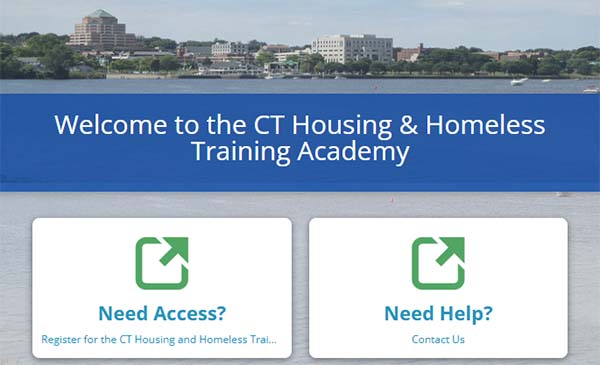
To begin using the platform click on the button below and follow these steps:
- On the welcome screen, click "Need Access?"
- On the next page, complete the form and click "Request CT LMS Access"
- You will receive a welcome email, click the link provided to set your password
- Access your training by logging in at cthousingacademy.myabsorb.com
Upcoming Trainings
In addition to our online catalog, the following upcoming trainings are open to participants via Zoom.
Talk Saves Lives: An Introduction to Suicide Prevention
Thursday, November 5, 2026, 10:00am - 11:30am
Presenter: Dani Amaral
Suicide Prevention Program Lead
Southeastern Regional Action Council (SERAC)
Talk Saves Lives is an introductory suicide prevention training that provides participants with an overview of the scope of suicide, current research on suicide prevention, and practical actions individuals can take to help save lives.
The training explores the impact of suicide and the factors that can contribute to suicide risk, while also highlighting protective factors and opportunities for prevention. Participants will learn about the warning signs and risk factors associated with suicide, common misconceptions, and the importance of recognizing changes in behavior or circumstances that may indicate someone is struggling.
The training also introduces evidence-informed approaches to suicide prevention and emphasizes the role that individuals, organizations, and communities can play in creating environments where people feel supported and connected. Participants will gain practical strategies for starting conversations about suicide, responding when someone may be at risk, and connecting individuals with appropriate support and resources.
By the end of this training, participants will have a greater understanding of suicide prevention and increased confidence in recognizing opportunities to offer support and help connect someone to life-saving resources.
Homeless Diversion Part 2: Putting Diversion into Practice
Friday, November 6, 2026, 10:00am - 11:30am
Presenters: Bobbi T. Riddick-Jackson
Community Impact Program Manager
Connecticut Coalition to End Homelessness (CCEH)
Samm Williams
Emergency Shelter Support Manager
Connecticut Coalition to End Homelessness (CCEH)
Building on Homeless Diversion: The Alternative to Homelessness, this training moves beyond the principles of diversion to focus on how to put those principles into practice. Through realistic scenarios, demonstrations, and case examples, participants will observe diversion conversations as they unfold and explore how staff can use practical tools and strategies to identify housing options, uncover strengths and natural supports, navigate barriers, and develop housing-focused solutions. Guided discussion will highlight the decisions, communication approaches, and problem-solving strategies used throughout each scenario while keeping dignity, choice, and participant autonomy at the center.
Training Objectives
- Observe the 6 Steps to Housing Problem-Solving Conversations demonstrated through realistic diversion scenarios.
- Identify how active listening, empathy, and strengths-based questions can help uncover the housing problem beneath the immediate crisis.
- Explore how staff can identify safe alternatives to shelter, including natural supports, community resources, and creative housing solutions.
- Examine practical tools that can help households brainstorm options, assess barriers, and identify realistic next steps.
- Recognize how a conversation can move from “I need a shelter bed” toward housing-focused problem-solving without making assumptions or prematurely offering referrals.
- Observe how common diversion challenges can be addressed through realistic scenarios and case examples.
- Identify how to develop a participant-driven diversion plan and follow-up strategy based on the household’s goals, strengths, and available resources.
Low Barrier Emergency Shelter: Housing-Focused Practice
Tuesday, November 10, 2026, 9:00am - 12:30pm
In-Person at CCADV, 100 Roscommon Dr Ste 110, Middletown, CT
*Please note that this training is capped at 50 participants and registration is required to attend.
Presenter: Samm Williams
Emergency Shelter Support Manager
Connecticut Coalition to End Homelessness (CCEH)
In the world of homeless response, few concepts are as misunderstood—or as transformative—as low barrier emergency shelter. This interactive training invites participants to explore both the philosophy and practical application of a shelter model that recognizes housing as a foundation for safety, dignity, and stability.
Participants will examine housing focused principles and what it means to truly meet people where they are. Through facilitated discussion, real-world scenarios, reflection, and practice-based examples, participants will explore the difference between structure and control, engagement and compliance, and safety and exclusion.
The training will explore how effective shelter operations, trauma-informed interactions, participant choice, restorative accountability, and thoughtful policies can work together to create environments that reduce barriers, strengthen connections, and support rapid movement toward permanent housing.
Participants will also examine the relationship between policy, practice, and program culture, considering how shelter rules, physical spaces, staff interactions, documentation, and everyday language communicate expectations and shape participant experiences. The session will encourage participants to identify opportunities to shift practices and language toward solutions that are both responsive and housing-focused.
The training will also highlight the role of data in understanding shelter effectiveness and telling the story of participant progress and system outcomes. Participants will consider how data can be used not simply for compliance or reporting, but as a tool for identifying barriers, strengthening practice, and supporting system improvement.
Designed for new and experienced shelter practitioners, supervisors, outreach staff, housing navigators, and system leaders, this training provides practical tools, language, and strategies that can be applied within shelter programs and across the homeless response system.
Learning Objectives
By the end of this training, participants will be able to:
- Describe the foundational principles of low barrier sheltering and housing-focused practices.
- Identify strategies for maintaining safety while minimizing unnecessary barriers to shelter access and engagement.
- Examine shelter policies, procedures, handbooks, and language through a housing-focused lens.
- Apply trauma-informed and choice-based approaches to strengthen participant engagement.
- Distinguish between supportive structure and practices that may unintentionally create barriers or reinforce compliance-based approaches.
- Identify opportunities to use participant choice, restorative accountability, and effective communication to support engagement.
- Use data to better understand participant outcomes, identify barriers, and communicate progress toward system-level goals.
Through discussion, scenarios, and practical application, participants will leave with a stronger understanding of how low barrier and housing-focused practices can be implemented in ways that are structured, flexible, safe, and deeply human.
Naloxone Training for the Homeless Response System
Thursday, November 19, 2026, 10:00am - 11:00am
Presenter: Abigail Lieberman, MPH
Supervisor, Change the Script
Wheeler Health
This practical training provides staff working within the homeless response system with foundational knowledge and skills to recognize and respond to an opioid overdose and support individuals who may be at increased risk of overdose.
Participants will learn about naloxone, including how it works, when it should be administered, and key considerations for distributing and carrying naloxone in homeless response settings. The training will review common signs and symptoms of an opioid overdose and provide guidance on appropriate steps to take when an overdose is suspected, including when and how to access emergency medical assistance.
The session will also introduce risk reduction principles that staff can incorporate into everyday interactions with participants. Participants will explore factors that can increase overdose risk, including changes in tolerance, mixing substances, using alone, and transitions in housing or treatment. The training will emphasize meeting people where they are, providing accurate information, and connecting individuals with appropriate resources without judgment.
Through discussion and practical examples, participants will consider how shelter, outreach, housing, and other homeless response staff can play an important role in increasing access to naloxone, recognizing an emergency, supporting participant safety, and connecting people to additional services and resources.
Learning Objectives
By the end of this training, participants will be able to:
- Describe what naloxone is and its role in responding to opioid overdose.
- Identify common signs and symptoms of an opioid overdose.
- Describe appropriate steps to take when an overdose is suspected.
- Explain key considerations for naloxone distribution, storage, and access in homeless response settings.
- Identify common factors that can increase overdose risk.
- Apply basic risk reduction principles when working with individuals who use substances.
- Identify opportunities to provide naloxone, overdose education, and connections to appropriate resources as part of routine homeless response practice.
McKinney-Vento 101
Tuesday, December 1, 2026, 10:00am - 12:00pm
Presenter: Michelle Anderson, MSW
Director of Early Childhood Programs
EdAdvance
McKinney-Vento Homeless Assistance Act Overview: Understanding the Law, Implications for Homeless Service Providers, and the Impact on Families Experiencing Homelessness.
An estimated 2 million children and youth experience homelessness each year in the United States. The McKinney-Vento Homeless Assistance Act provides important rights, protections, and services designed to ensure that children and youth experiencing homelessness have access to educational opportunities and the support they need to succeed.
Under McKinney-Vento, every school district is required to follow the legislation and designate a McKinney-Vento Liaison to support students and families experiencing homelessness. The law focuses on removing barriers to PreK–12 educational access, enrollment, attendance, and academic success for students experiencing homelessness.
This workshop will provide an overview of the McKinney-Vento Act and explore how the law applies to children, youth, families, schools, and community service providers. Participants will learn about the identification and eligibility of students experiencing homelessness, enrollment requirements, the role and responsibilities of McKinney-Vento Liaisons, and the educational rights and protections available to eligible students.
The training will also highlight the importance of collaboration between schools, homeless service providers, and community organizations. Participants will explore how strong community connections and coordinated resources can help address barriers faced by families experiencing homelessness and support positive outcomes for students and their families.